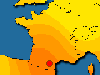
 The
Château de St-Ferriol lies in the foothills of the Pyrenees,
a short drive away from the Mediterannean coast, from the Spanish
border, and from Andora.
The
Château de St-Ferriol lies in the foothills of the Pyrenees,
a short drive away from the Mediterannean coast, from the Spanish
border, and from Andora.
St-Ferriol is a small village, in the Aude Departement (Languedoc-Roussillon
Region) of France. Historically the area was called the Razès,
part of an independent state under the Viscounts of Carcassonne,
until it was annexed to France following the war against the
Cathars. Some people here still speak Occitan, the Langue
d'oc as, just a few miles away, the people of the Rousillon
still speak Catalan.
The area best known for its Cathar history. In the twelfth century
a gnostic religion rivalling Roman Catholicism flourished in
this area under the tolerant rule of the Counts of Toulouse.
The Roman Church, fearing the rapid spread of a rival faith
launched a full-scale crusade against the local population.
As direct consequences, the Dominican Order and the infamous
Inquisition was founded, and the Languedoc was annexed to France.
Click on the following link to open a website on Cathars
in a new window.
The château is within sight of Rennes-le-château, the
focus of numerous mysteries involving hidden treasure, and features
in some of the theories concerning the geometric arrangement
of important buildings in the area.
The area has many features of interest. For Walking and various
sports see the section on Activities. This section coveres things
to see in the area.
Carcassonne
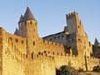 is
the largest surviving medieval walled city in Europe and a World
Heritage site. Inside is the castle of the viscounts of Carcassonne.
The whole city was restored in the nineteenth century. It is best
visited out of season. Although rarely claimed as such, Carcassonne
has as a good a claim as any to be a Cathar Castle.
is
the largest surviving medieval walled city in Europe and a World
Heritage site. Inside is the castle of the viscounts of Carcassonne.
The whole city was restored in the nineteenth century. It is best
visited out of season. Although rarely claimed as such, Carcassonne
has as a good a claim as any to be a Cathar Castle.Cathar Castles
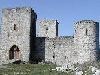
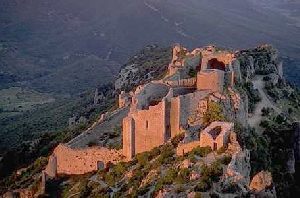
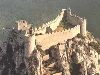 St-Ferriol lies in the heart of Cathar Country, within easy reach
of many Cathar strongholds including Montsegur, Puivert, Puilaurens,
Peyrepertuse, Aguilla, Queribus and Usson. Just up a local path
are the ruins of a Cathar castle where Cathar bishops are known
to have taken refuge during the Cathar persecutions of the thirteenth
century, and there are others within walking distance including
Le Bèzu and Caustoussa.
St-Ferriol lies in the heart of Cathar Country, within easy reach
of many Cathar strongholds including Montsegur, Puivert, Puilaurens,
Peyrepertuse, Aguilla, Queribus and Usson. Just up a local path
are the ruins of a Cathar castle where Cathar bishops are known
to have taken refuge during the Cathar persecutions of the thirteenth
century, and there are others within walking distance including
Le Bèzu and Caustoussa. Cathedrals, Abbeys and historic Churches
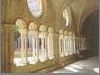 In
addition to the spectacular medieval cathedrals in nearby cities,
there are also a number of other cathedrals at St-Papoul and Alet.
There ae also famous abbeys such as Lagrasse, St-Polycarp and
St-Hillare - where sparkling white wine was invented and from
where the inhabitants of Champaigne got the idea for their wine.
Within walking distance of St-Ferriol is a village (Campagne)
which belonged to the Knights Templar.
In
addition to the spectacular medieval cathedrals in nearby cities,
there are also a number of other cathedrals at St-Papoul and Alet.
There ae also famous abbeys such as Lagrasse, St-Polycarp and
St-Hillare - where sparkling white wine was invented and from
where the inhabitants of Champaigne got the idea for their wine.
Within walking distance of St-Ferriol is a village (Campagne)
which belonged to the Knights Templar.Historic Villages
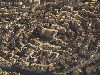
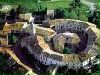 Unusual villages abound in the area. Since ancient times people
here have build defensible settlements on hill tops. Greek, Pheonician
and Roman oppidans have been excavated, and many medieval bastides
survive. Perhaps the most spectacular examples are the "circulades"
- villages built around a hill top church or castle, their circular
road plan most obvious from the air.
Unusual villages abound in the area. Since ancient times people
here have build defensible settlements on hill tops. Greek, Pheonician
and Roman oppidans have been excavated, and many medieval bastides
survive. Perhaps the most spectacular examples are the "circulades"
- villages built around a hill top church or castle, their circular
road plan most obvious from the air.Roman Remains
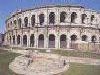
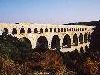 The area was long a Roman colony and there are many vestiges of
their occupation. A notable example is the Via Domitia a road
which once joined Rome to the Iberian Peninsular. The route follows
the one by Hannibal and his elephants on their way to the Alps,
and is in turn largely followed by the modern Autoroute (The "Languedocienne").
Within driving distance you can find the Oppidum at Enserum, the
tallest Roman aquaduct ever built, and a spectacular area still
used for bullfights.
The area was long a Roman colony and there are many vestiges of
their occupation. A notable example is the Via Domitia a road
which once joined Rome to the Iberian Peninsular. The route follows
the one by Hannibal and his elephants on their way to the Alps,
and is in turn largely followed by the modern Autoroute (The "Languedocienne").
Within driving distance you can find the Oppidum at Enserum, the
tallest Roman aquaduct ever built, and a spectacular area still
used for bullfights.Natural Features
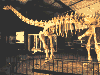
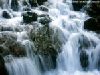
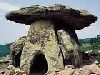
 The area is rich in geologically features, including ancient caverns
and hot springs. There are dinosaur fossils and evidence of occupation
by prehistoric peoples (the earliest known in Europe).
The area is rich in geologically features, including ancient caverns
and hot springs. There are dinosaur fossils and evidence of occupation
by prehistoric peoples (the earliest known in Europe).  Some unique dinosaur finds have been made at a local village (Campagne)
and a local town (Espéraza) boasts the only museum in the
world dedicated to dinosaurs.
Some unique dinosaur finds have been made at a local village (Campagne)
and a local town (Espéraza) boasts the only museum in the
world dedicated to dinosaurs. Wildlife and Countryside
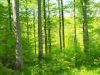
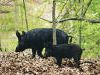
 The surrounding countryside is beautiful and varied. To the
South are the foothills of the Pyrenees, then the real Pyrenees,
and the Spanish border, about an hour's drive away. One of the
minor pilgrimage routes to Santiago (St-Jacques) de Compostella
passes through Limoux, Espéraza, the Gorge de Pierre-Lys, through
the mountains and on into Spain. To the East are the Corbières,
one of the few remaining wildernesses in Europe, where boar
still roam wild, and beyond it the Mediterranean coast, including
Perpignan and a number of holiday beaches.
The surrounding countryside is beautiful and varied. To the
South are the foothills of the Pyrenees, then the real Pyrenees,
and the Spanish border, about an hour's drive away. One of the
minor pilgrimage routes to Santiago (St-Jacques) de Compostella
passes through Limoux, Espéraza, the Gorge de Pierre-Lys, through
the mountains and on into Spain. To the East are the Corbières,
one of the few remaining wildernesses in Europe, where boar
still roam wild, and beyond it the Mediterranean coast, including
Perpignan and a number of holiday beaches.

 To the West lies the Plateau de Sault, a high plateau of forests
and rolling countryside, and beyond it Andorra. To the north
are vineyards and historic cities like Carcassonne.
To the West lies the Plateau de Sault, a high plateau of forests
and rolling countryside, and beyond it Andorra. To the north
are vineyards and historic cities like Carcassonne.